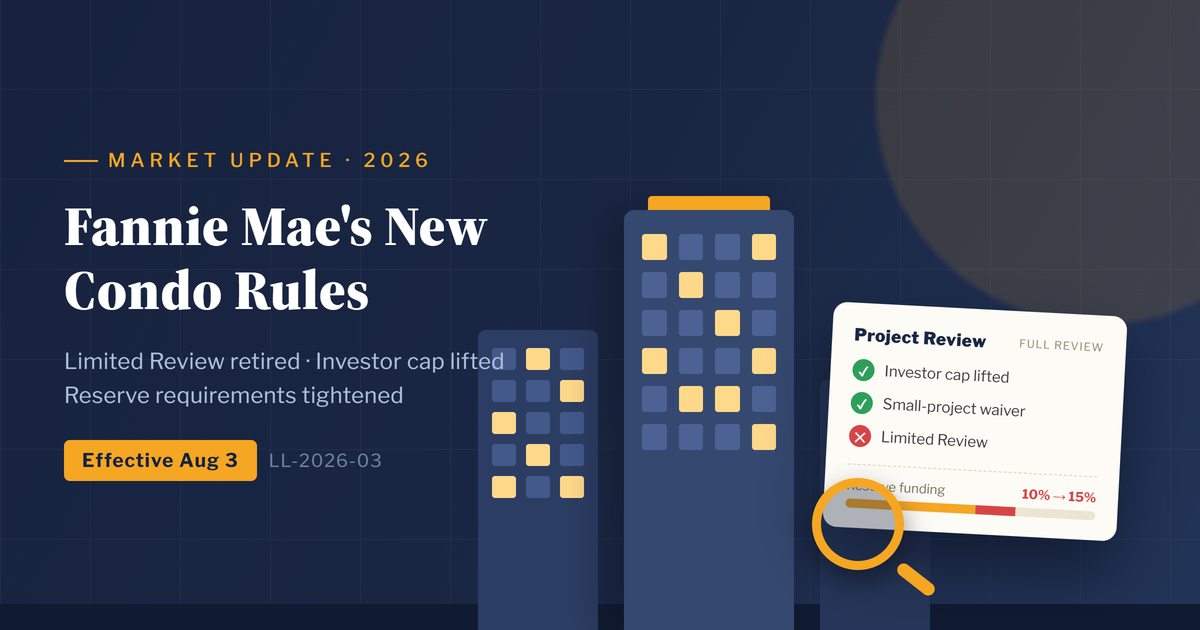
Fannie Mae's 2026 Condo Lending Overhaul: What Buyers, Sellers, and Agents Need to Know
In March 2026, Fannie Mae issued Lender Letter LL-2026-03 — one of the most significant overhauls to condominium lending standards in years. Changes roll out in phases starting August 3, 2026. Here's what actually matters.
✅ The Good News
1. The 50% Investor Cap Is Gone
Fannie Mae no longer limits investor-owned units to 50% of a condo project. This opens up financing in downtown high-rises, resort buildings, and urban markets where rental ownership is common — buildings that previously disqualified buyers outright, regardless of how creditworthy they were.
2. Small Buildings Get a Pass
The project review waiver now covers buildings with up to 10 units (up from 4). Small boutique condos can bypass the full HOA review process, making conventional financing easier to access for buyers in smaller developments.
❌ The Not-So-Good News
Limited Review is dead — and that raises the bar for everyone.
More paperwork, longer timelines
Every established condo now goes through Full Review. Lenders will scrutinize HOA financials, reserve balances, and insurance in detail — no more streamlined approvals. Expect longer processing times on condo transactions.
More condos may not qualify
HOAs with underfunded reserves, deferred maintenance, or incomplete financials are now at real risk of losing access to conventional financing for their buyers — directly impacting property values and sale timelines.
Reserve funding rules are getting stricter
Starting August 3, 2026: HOAs using a reserve study must follow the highest recommended funding allocation — the old “minimum balance” approach is no longer permitted. By January 4, 2027: the minimum reserve allocation rises from 10% to 15% of annual HOA assessment income.
📌 Important: Reserve funding is just one factor
Full Review also evaluates insurance adequacy, deferred maintenance, active HOA litigation, pending special assessments, and documentation completeness. A project can meet the reserve threshold and still not qualify if other conditions aren't satisfied.
⚠️ Urgent: Deadline August 3, 2026
If you have a condo loan currently eligible for Limited Review, get it fully submitted to underwriting before August 3. Any application dated on or after August 3 must comply with the new rules — no exceptions.
What You Should Do — By Role
🏠 Buyer
- →Before making an offer, ask your agent to request the HOA's current budget and reserve study from the seller.
- →Verify the reserve study is dated within the last 3 years — older studies won't satisfy the new Fannie Mae requirements.
- →Ask your loan officer to confirm the master insurance structure. If the HOA policy carries a per-unit deductible, you'll need an HO-6 policy — budget for it.
- →Ask whether there are any pending special assessments or known deferred maintenance. These can trigger additional lender scrutiny and even kill the loan.
- →If your current loan qualifies for Limited Review, get it submitted before August 3 — don't wait.
🤝 Buyer's Agent
- →Request HOA documents early — ideally before writing an offer: current budget, reserve study, master insurance certificate, and last 2 years of HOA meeting minutes.
- →Check two things: Is the reserve study dated within 3 years? Is the annual reserve contribution at least 10% of total HOA income?
- →Red flags to watch: no reserve study, reserves below 10%, active HOA litigation, large pending special assessments, or a high per-unit deductible with no HO-6 in place.
- →Loop in the buyer's LO before going under contract — they can run a preliminary eligibility check via Fannie Mae's Condo Project Manager (CPM) database.
- →Know this for every building you work: is it ready for conventional financing today, or does it need HOA remediation first?
🏷️ Seller
- →Ask your HOA management company for: current budget, reserve study, master insurance cert, and 2 years of meeting minutes.
- →Share these proactively with any buyer's lender — it speeds up Full Review and reduces deal fall-through risk.
- →If reserves are underfunded, talk to your HOA board now. It's fixable, but not overnight.
- →The honest answer to buyers: is your condo harder to sell now? Not if your HOA is financially healthy. Get the docs ready and demonstrate it.
🏷️ Listing Agent
- →Order condo docs before listing: budget, reserve study, master insurance, meeting minutes. Don't wait for the buyer to ask.
- →Assess the building frankly: ready for conventional financing today, or needs HOA remediation first?
- →Build longer timelines into your listing strategy — Full Review can add 1–2 weeks vs. what Limited Review used to take.
- →Prepare buyer-agent talking points about your building's reserve status. Transparency kills surprises.
🏢 HOA Board Member
- →Pull your most recent reserve study. Is it dated within the last 3 years? If not, commission one now — this is a hard requirement effective August 3, 2026.
- →Calculate your reserve contribution rate: divide your annual reserve budget line by total HOA assessment income. Must be at least 10% now, rising to 15% by January 4, 2027.
- →Review your master insurance policy with your HOA insurance agent. Does it have a per-unit deductible? If yes, ensure unit owners know they need an HO-6 policy.
- →Ask your HOA management company or counsel to audit your financials for Fannie Mae compliance. The cost is small compared to the risk of losing buyer financing across your entire community.
📈 Real Estate Investor
The removal of the 50% investor concentration cap is significant — but understand the nuance:
- →Who benefits most: Conventional loan investors buying in established buildings that previously exceeded the 50% investor threshold. Those buildings are now back in play.
- →DSCR/Non-QM borrowers: The cap removal helps project eligibility for conventional loans. If you're using DSCR, confirm with your LO — lenders have separate condo approval standards for non-QM.
- →Full Review still applies: The 50% cap was one disqualifier removed, but HOA financials, reserves, and insurance still need to clear. The friction isn't gone, just reduced.
- →Before making an offer: ask whether the building is already approved in Fannie Mae's Condo Project Manager (CPM) or has recently cleared a Full Review.
Quick Summary
| Change | Impact | Effective Date |
|---|---|---|
| 50% investor concentration limit retired | ✅ Good — more buildings qualify | Immediate |
| Small project waiver expanded (4 → 10 units) | ✅ Good — more small buildings qualify | Immediate |
| Limited Review retired | ❌ Bad — stricter process for most condos | August 3, 2026 |
| Reserve study rules tightened | ❌ Bad — HOAs need current, compliant studies | August 3, 2026 |
| Reserve requirement raised (10% → 15%) | ❌ Bad — HOAs need stronger reserve funding | January 4, 2027 |
| Per-unit deductibles up to $50,000 allowed | ⚠️ Neutral — HO-6 required when applicable | July 1, 2026 |
| Roof ACV coverage now permitted | ✅ Good — eases insurance costs | Immediate |
📋 What the Insurance Changes Mean in Practice
- •Per-unit deductible (up to $50K): If your HOA's master policy has a per-unit deductible, buyers must carry an HO-6 (unit owners) policy covering at least that amount. Buyers: ask your insurance agent about this when shopping for a condo — it's an additional monthly cost to factor in.
- •Roof ACV coverage: Roofs no longer need to be insured at full replacement cost — actual cash value (ACV) is now acceptable. This should ease HOA insurance costs in markets like Florida and Texas where replacement-cost roof coverage has become expensive or hard to find.
- •For HOA boards and insurance agents: Under Full Review, lenders examine the master policy's deductible structure, coverage sufficiency, and loss settlement terms. Ensure your policy is up to date before the next buyer's lender sends a condo questionnaire.
FAQ
My condo loan is already in underwriting — am I affected?
No. If your loan is fully submitted and not deemed incomplete before August 3, your Limited Review eligibility is honored under the old rules.
Does this affect FHA or VA loans?
No. These are Fannie Mae (conventional) guidelines only. FHA and VA condo approval processes are governed by different agencies.
How do I know if my HOA qualifies?
Ask for the latest HOA budget and reserve study. The key question: is at least 10% (rising to 15% after January 4, 2027) of annual dues allocated to reserves? A Tiger Loans loan officer can help you assess eligibility early.
What is the difference between Full Review and Limited Review?
Limited Review (now retired) was a streamlined process for established condos requiring minimal documentation. Full Review is comprehensive — lenders examine HOA financials, reserve funding, insurance, and occupancy data in detail.
Have a Condo Deal in Process?
Talk to a Tiger Loans loan officer today. We'll review your condo's eligibility and help you meet the August 3 deadline if needed.
Talk to a Loan OfficerThis article is for informational purposes only and does not constitute legal or financial advice. Lending policies are subject to change. Contact a licensed mortgage professional for guidance specific to your situation. Tiger Loans, Inc. NMLS #1169300. Licensed in AZ, CA, CO, FL, GA, ID, IL, IN, MD, NV, NC, TX, WA. Broker in MA and VA. Equal Housing Lender.